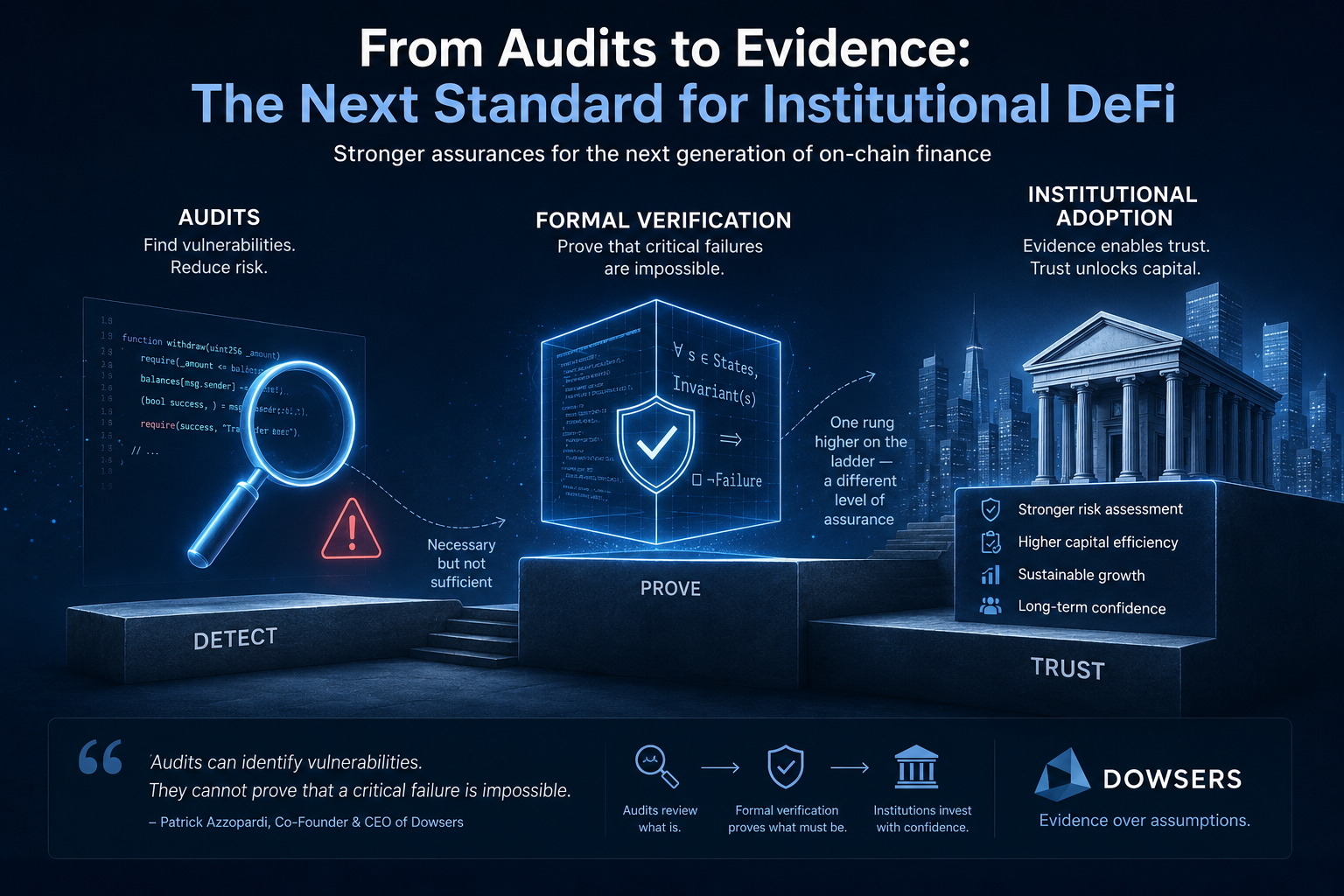
Following Patrick Azzopardi’s recent interview with The Big Whale, a closer look at why formal verification is becoming a critical layer of trust for on-chain finance and institutional DeFi is entering a new phase.
Why Institutional DeFi Needs More Than Security Audits.
Institutional DeFi is entering a new phase. In a recent interview with The Big Whale, Patrick Azzopardi, Co-Founder and CEO of Dowsers, made a simple observation: Audits can identify vulnerabilities. They cannot prove that a critical failure is impossible.
For institutions allocating capital on-chain, that distinction is becoming increasingly important. Tokenized funds, stablecoins, lending markets, and other forms of on-chain financial infrastructure are attracting growing interest from asset managers and regulated financial institutions. Yet despite the opportunities, one question continues to slow adoption: How can investors trust the code securing billions of dollars in value?
The Institutional Trust Problem
Traditional finance relies on established frameworks for assessing risk.
Investors can review financial statements, credit ratings, regulatory filings, and decades of historical data. In DeFi, much of that infrastructure is still being built.
When evaluating a protocol, institutions must assess:
- Smart contract risk;
- Governance risk;
- Operational resilience;
- Dependencies on external protocols;
- Upgrade mechanisms and administrative controls.
This creates a challenge that is both technical and strategic.
A protocol may generate attractive yields, but if investors cannot confidently assess its resilience, capital is unlikely to follow.
Why Audits Are Necessary, But Not Sufficient
Security audits remain one of the most important practices in the DeFi ecosystem. They identify vulnerabilities, improve code quality, and reduce deployment risk.
But audits have limits.
An audit is ultimately an expert review conducted at a specific moment in time. It can uncover problems, but it cannot mathematically prove that certain classes of failures are impossible.
History has repeatedly shown that protocols can pass multiple audits and still suffer critical exploits.
For institutional investors, this raises an important question:
What comes after audits?
One Step Further: Formal Verification
Formal verification sits one rung higher on the same ladder, except it isn’t really the same ladder at all. An audit asks whether experts were able to identify vulnerabilities. Formal verification asks whether a critical failure scenario can be proven impossible. As Patrick Azzopardi put it in his interview: “It’s a scientific fact.”
The approach transforms software into a mathematical model and verifies whether specific properties always hold under defined assumptions. For smart contracts, those properties can include:
- Preventing unauthorized withdrawals;
- Ensuring assets cannot become permanently locked;
- Verifying governance mechanisms behave as intended;
- Preserving critical protocol invariants across all possible execution paths.
- List
This moves security from expert opinion toward mathematical evidence.
The distinction may seem subtle, but for institutions responsible for managing client capital, it is significant.
Why This Matters for the Future of On-Chain Finance
Formal verification is not a new concept.
It has been used for decades in industries where software failure is unacceptable, including aerospace, transportation, and industrial systems.
As digital assets become part of mainstream financial infrastructure, the standards applied to smart contracts are naturally evolving.
Institutions are not simply looking for systems that appear secure.
They are increasingly looking for systems whose most critical properties can be demonstrated, documented, and independently verified.
In that context, formal verification is becoming less of a niche practice and more of a foundational layer of trust.
Dowsers’ Perspective
At Dowsers, we believe the next phase of institutional DeFi adoption will require stronger forms of assurance than the industry has traditionally relied upon.
Our work focuses on helping protocol teams and institutional investors gain greater confidence in the behavior of critical smart contracts through formal verification.
The objective is straightforward:
replace assumptions with evidence wherever possible.
As Patrick Azzopardi discussed in his interview with The Big Whale, the future of on-chain finance will depend not only on innovation, but on the industry’s ability to provide increasingly rigorous guarantees around security and protocol behavior.
Read the Full Interview
Patrick Azzopardi recently spoke with The Big Whale about formal verification, institutional adoption, and the future of smart contract assurance.
If you’re interested in how the security standards of on-chain finance are evolving, the full interview provides additional insights into the challenges and opportunities ahead.
Read the interview →
https://www.thebigwhale.io/article/patrick-azzopardi-dowsers-we-guarantee-asset-managers-that-the-defi-protocols-they-use-are-bulletproof
As on-chain finance matures, institutions will demand the same thing they demand everywhere else: evidence.
Not confidence.
Not assumptions.
Evidence.
Interested in formal verification or protocol assurance?
Get in touch with the Dowsers.
Hacks in DeFi cost digital asset holders a stunning $2 billion per year and erode trust in builders' protocols.
Avoid hacks