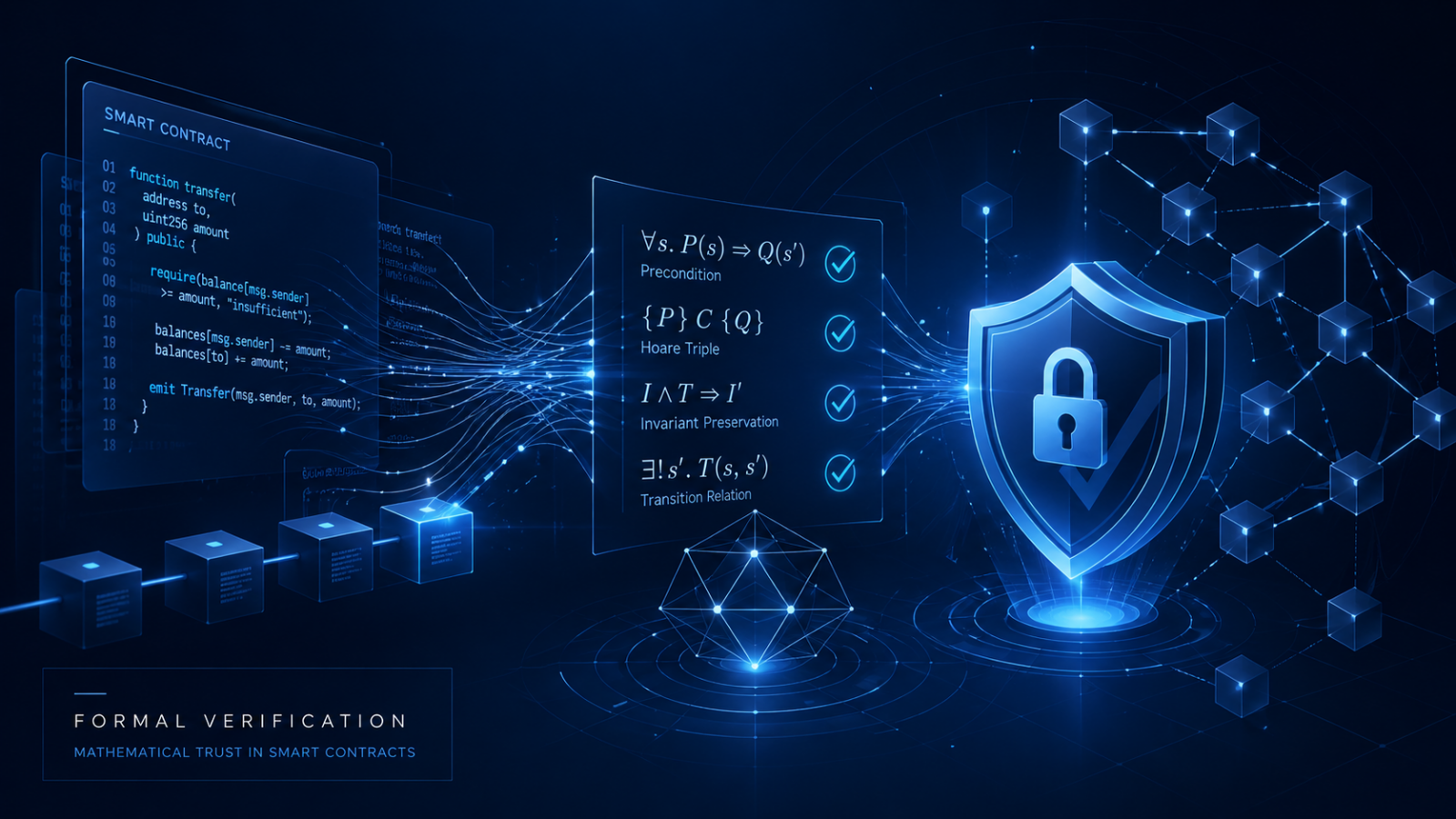
Formal verification is becoming a critical layer of assurance for on-chain finance.
Smart contracts are becoming core financial infrastructure. They control assets, liquidity, permissions, governance mechanisms, and financial flows. But when code directly moves value, traditional security reviews are no longer enough on their own.
In a new article published by Financial Columnist, Patrick Azzopardi, Co-founder and CEO of Dowsers, explains how formal verification for smart contracts helps establish mathematical trust in on-chain systems.
Unlike traditional testing, manual audits, or AI-assisted code review, formal verification does not only look for vulnerabilities. It proves whether critical security properties are satisfied within a defined mathematical model and specification. This makes it especially valuable for DeFi protocols, stablecoins, tokenized assets, and institutional on-chain finance.
Why formal verification for smart contracts matters
Most security methods are based on exploration. Audits rely on expert review. Testing checks selected scenarios. Fuzzing explores many possible inputs. AI can accelerate analysis and detect patterns at scale.
All of these methods are useful. But none of them can fully guarantee that a critical failure is impossible.
Formal verification brings a different level of assurance. It translates the smart contract’s behavior into a mathematical model, defines the properties that must always hold, and then uses automated reasoning to prove whether those properties can be violated.
For example, formal verification can help prove that unauthorized minting cannot occur, that balances cannot be incorrectly updated, that access-control rules cannot be bypassed, or that a token’s critical behavior remains consistent under all relevant execution paths.
This is why formal verification is becoming increasingly important as on-chain finance matures. The more value smart contracts secure, the more the industry needs guarantees that go beyond best-effort reviews.
At Dowsers, we believe the future of smart contract security will not rely on one method alone. Human expertise, AI, audits, testing, fuzzing, and formal verification all have a role to play. But when the question is whether a critical failure can occur, mathematical proof becomes essential.
Our formal verification platform is designed to make this level of assurance more accessible, scalable, and practical for builders, investors, audit firms, and institutions operating in on-chain finance.
Hacks in DeFi cost digital asset holders a stunning $2 billion per year and erode trust in builders' protocols.
Avoid hacks